 Ston
Ston: token swaps and liquidity
Ston is a decentralized exchange with TON liquidity pools and cross-chain swaps between TON, TRON, and supported EVM networks. EVM networks use the Ethereum Virtual Machine to run compatible smart contracts. Omniston gathers quotes from connected liquidity sources before the wallet authorizes execution. Pools supply swap liquidity, while farming and STON staking provide separate forms of participation.
Table of contents
A swap changes the tokens you hold; a pool deposit creates a liquidity position with exposure to both assets. Quotes, pool fees, and contract terms determine what each action costs and what it delivers.
The short version: Cross-chain quotes describe a proposed swap, while settlement status and destination transfers establish the assets that actually arrive.
TON pools and Omniston connect liquidity with swaps
TON pools supply assets for trades, and Omniston compares executable quotes across the liquidity sources that connect to it. An automated market maker (AMM) uses a pool’s pricing rules to determine the exchange between its assets. Ston’s constant-product pools use reserve balances to price swaps. The pool family also includes Stable, WStable, and WCPI designs.
Aggregation adds a layer above those liquidity sources. A request for quote (RFQ) asks connected resolvers for terms for the selected assets and amount. Resolvers are participants that provide quotes and perform settlement actions. Omniston can incorporate TON AMM liquidity and resolver liquidity, including assets that a resolver supplies on a cross-chain order’s destination network.
Wallet connections and quotes define the trade
Asset identity and destination compatibility
The connected wallet authorizes spending on the source network, while the destination address identifies where the output belongs. These roles may involve different networks in a cross-chain swap. On TON, jettons are fungible tokens. Their contract addresses distinguish assets that share similar names, and the receiving address must match the selected destination network.
A wallet connection establishes access to signing. It does not establish that a particular asset pair has an executable quote.
Quoted output and completed settlement
A quote states proposed terms, and the wallet signature authorizes the required action. Submission then starts the applicable settlement flow. Completion depends on that flow reaching its successful state and delivering the destination asset. An approval prompt or a transaction identifier alone describes an earlier stage.
Cross-chain swaps support a defined set of assets, including USDT on TON and TRON. Live quotes also depend on the selected pair, amount, and available liquidity. Network support therefore does not promise a quote for every token pair.
The expected payout and the received payout become comparable when they refer to the same asset, destination, and settled trade. Before accepting a quote or reconciling its outcome:
- Confirm that the source asset and spending address use the same network.
- Match the destination asset with an address on its destination network.
- Compare the trader’s net output with the fees and minimum received that the quote displays.
- Accept only terms that remain valid under the quote’s deadline and selected execution limits.
- Treat a pending Omniston order as unresolved. A final partially filled order has settled only part of the trade; reconcile its received output against the quoted total.
Cross-chain execution coordinates the two settlement legs
Cross-chain swaps pair a source-side commitment with liquidity that a resolver supplies on the destination network. Omniston links cross-chain execution through hash time-locked contracts (HTLCs). Hashlocks connect the claims cryptographically, while timelocks define completion and rollback windows. An execution that cannot complete follows its refund or rollback path under those deadlines. Funds can remain locked during these phases, so a refund need not be immediate. Settlement can involve multiple executions; the overall order status records its outcome.
Trading fees and price movement affect different amounts
Each Ston pool has its own configurable trading fee. Pool settings distinguish the liquidity-provider portion from the protocol portion. The current configuration determines the applicable rates, which the pool details display. Provider fees accrue in the pool, and each provider’s share determines their entitlement to those fees.
Price impact describes how the trade changes a pool’s price through its reserve balances. A larger trade relative to available liquidity generally creates more impact. Slippage describes movement between the quoted price and execution. The minimum received expresses the lowest output that the selected tolerance accepts; increasing that tolerance permits worse execution within the wider limit.
Network gas pays for blockchain operations and has a separate cost basis from trading fees. TON and TRON transactions incur network charges. EVM cross-chain flows can use signature-based authorization, but token or wallet compatibility can require a gas-paying approval. A gasless swap path therefore needs its own eligibility check, including any initial approval that the token requires.
For Omniston order quotes, the trader’s net destination output excludes protocol and integrator fees that apply. A resolver’s total destination transfer can include those fees, so it can exceed the amount allocated to the trader.
Pool shares, farming, and STON staking create different positions
Liquidity provision and pool exposure
Providing liquidity creates a share of a TON pool, represented by liquidity provider (LP) tokens. These tokens represent a claim on the underlying assets, whose proportions can change as swaps alter the reserves. The provider’s share, trading volume, and the pool’s fee configuration determine fee income. Relative token-price movements can also create impermanent loss: the position can underperform holding the original assets separately. Swap fees may offset some of that difference, but they do not remove the exposure. Pool selection therefore involves both the trading activity and the assets that the position holds.
The impermanent-loss protection program specifies the USDT/STON v2 pool and separately announced validity periods. Eligibility requires liquidity before a period starts, and payouts depend on the minimum liquidity maintained during that period. Eligibility conditions and payout caps limit the program’s discretionary compensation.
Farming with LP tokens
Staking LP tokens in a farm qualifies you for additional token rewards alongside the pool’s trading fees. Reward schedules and the farm’s terms determine eligibility and accrual. Some positions have lockups; those conditions govern when you can withdraw the staked LP tokens. An estimated annual percentage rate (APR) describes an annualized projection, and changing liquidity or incentives can change that projection.
STON staking and governance
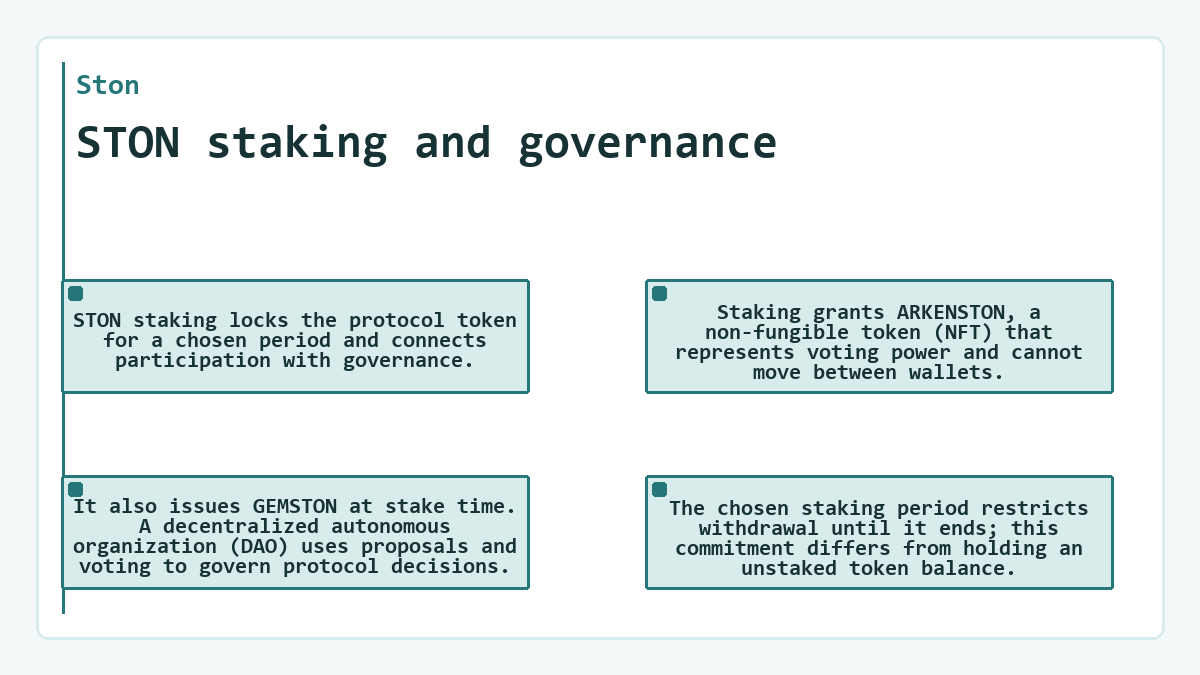
STON staking locks the protocol token for a chosen period and connects participation with governance. Staking grants ARKENSTON, a non-fungible token (NFT) that represents voting power and cannot move between wallets. It also issues GEMSTON at stake time. A decentralized autonomous organization (DAO) uses proposals and voting to govern protocol decisions. The chosen staking period restricts withdrawal until it ends; this commitment differs from holding an unstaked token balance.
Contract exposure and integration choices shape ongoing use
Keys and deployed contracts
Private keys stay in the wallet, while pool deposits and locked positions place assets or position tokens into contracts. Those contracts’ withdrawal rules govern access during the position’s life. Trail of Bits reviewed the TON AMM v2 contracts, and public TON contract code permits inspection. Audit coverage follows the named contracts and version; other components can have different coverage.
Wallet applications and developer tools
Wallet integrations, including Tonkeeper, offer another entry path to swaps. A software development kit (SDK) packages integration functions, while an application programming interface (API) exposes data or protocol services. Omniston supplies aggregation capabilities, and widgets embed supported swap flows inside applications. An integration’s network coverage and settlement support determine which operations it can offer; embedding a widget does not establish support for every route.
Pool monitoring should distinguish accrued trading fees from estimated farming incentives. A completed swap does not close a separate liquidity position or release a locked STON stake.
Ston: frequently asked questions
Does Ston require an exchange account or in-app identity verification?
Ston does not require an exchange account or an in-app know-your-customer (KYC) process for wallet-based swaps. You connect a compatible wallet and authorize the relevant actions through it. That access model concerns the exchange interface; it does not make public blockchain transactions private or change a wallet provider’s separate requirements.
Can I use a hardware wallet for TON transactions on Ston?
A TON-compatible hardware wallet can sign Ston transactions through a supported wallet connection. Ledger pairing through Tonkeeper provides a documented route using TON Connect. The hardware device keeps the private keys and requires transaction confirmation on the device. This TON setup does not establish compatibility with every EVM or TRON route.
What happens if I lose access to the wallet that I connected?
Wallet recovery depends on that wallet’s recovery methods, and Ston cannot restore your private keys or recover access for you. A valid seed phrase or other supported backup can restore signing access. Losing the wallet application does not delete on-chain assets, but access still requires the credentials that control the address.
How can a token issuer make a token tradable on Ston?
A token issuer can create and fund a TON liquidity pool for the token and a paired asset. The pool supplies liquidity for protocol-level swaps, and shallow liquidity can produce substantial price impact. Ston’s interface may hide or block tokens under its token policies, even when a pool exists on-chain. Token recognition or verification inside third-party wallets remains separate from pool creation; creating a pool does not establish wallet verification.
Can I supply liquidity with only one of a pool’s tokens?
Ston v2 supports single-sided arbitrary provision into an existing pool. This differs from a balanced simulation that accepts one input amount and calculates the matching amount for the other asset. Initial provision for a new pool requires positive amounts of both assets. Single-sided funding still creates a share of a two-asset pool.