 Ston
Ston first swaps within TON and across chains
Ston lets you exchange tokens within TON or swap supported assets between TON, TRON, and supported EVM networks using your wallet. For a first trade, prepare wallet access for the selected networks, then compare fees with the quoted output. Completion means receiving the output asset in the destination wallet after the relevant settlement process finishes.
Jump to a section
Keeping both assets on TON and receiving tokens on another blockchain create different preparation and settlement requirements. Omniston connects both paths through quotes, while cross-chain execution adds a destination network and timed contract conditions that a TON-only trade does not share.
Bottom line: The receiving address must match the selected destination network before a cross-chain swap can settle correctly.
A first swap that stays within TON
A TON-only swap exchanges assets on the same blockchain and uses a TON-compatible wallet for authorization. The swap interface takes the chosen input token, output token, and amount, then calculates the corresponding quote. The receiving asset stays on TON, even when the route draws liquidity from more than one connected source. The confirmation window displays the selected exchange, its expected output, and its costs before authorization. Check that your wallet has enough of TON’s native asset for the network fees required by the selected flow. The quoted input amount includes any fees charged in the input asset.
Omniston brings liquidity into the quote
Omniston requests executable terms from connected liquidity sources, so the quote can reflect liquidity beyond a single pool. A request for quote, or RFQ, describes the assets and amount that the trade needs. Connected resolvers respond with terms for that request; the available responses determine which routes can execute.
On TON, these sources include automated market makers and RFQ resolvers. An automated market maker prices exchanges using assets held in a liquidity pool. Cross-chain routes add resolver-supplied liquidity on the destination network.
Source and destination wallets serve different roles
The source wallet authorizes spending, and the destination address identifies where the output asset must arrive.
Spending on the source network
Wallet access must match the chain that holds the input asset. TON transactions use a compatible TON wallet, while supported EVM routes use compatible access to the selected Ethereum Virtual Machine network. A cross-chain trade therefore needs wallet access for both sides, with the spending authorization coming from the source side. The destination wallet does not supply the resolver’s liquidity.
Receiving on the destination network
The chosen output asset and receiving address must belong to the same destination chain. Network selection determines where the received balance exists, so a matching token name alone cannot establish compatibility. On TON, fungible tokens use the jetton standard; contract identity distinguishes tokens that share a name. For cross-chain trading, the supported asset list and a live quote establish whether the selected combination is available. A route between supported networks does not automatically cover every token on those networks.
The quote separates trading costs from network costs
Trading costs come from the selected liquidity route, while network costs cover the transactions needed for settlement. TON liquidity pools set trading fees individually. Compare the input amount with the net output that the quote assigns to the receiving wallet. Omniston’s net output accounts for applicable protocol and integrator fees. In order settlement, the amount that a resolver sends can also include fee portions, so that larger transfer amount is not the trader’s received balance.
Gasless execution can remove the native-gas requirement for the swap itself when the source is a supported EVM network. An initial token approval may still require gas, depending on the wallet, token, and available approval method. Some wallets can also make that approval gasless. TON and TRON routes have their own network costs, which the transaction preview must keep distinct from the trade’s exchange rate. No single advertised fee describes every combination of route, pool settings, authorization method, and network conditions.
Minimum received sets the acceptable output
The minimum received amount expresses the output boundary in the selected swap terms. In a TON swap route, an exchange that cannot meet its own required minimum output aborts.
The estimate and the eventual receipt
A quote estimates the exchange available for its input and route at that moment. Prices and liquidity can change before execution, so the estimated output and the eventual receipt describe different stages. Price impact concerns how the requested trade affects available pricing; slippage concerns movement between the quote and execution. A trading fee adds another cost with its own calculation basis.
The slippage tolerance
A wider tolerance permits a larger difference between quoted and acceptable execution terms where the route uses slippage settings. It does not create more liquidity. Review the minimum received amount alongside the selected output asset and quoted costs. Increasing a tolerance changes the permitted outcome, even when the input amount stays unchanged. A first swap needs an acceptable output boundary before the wallet authorizes spending.
TON, TRON, and EVM route choices
The interface supports TON-only trading and quoted cross-chain paths among TON, TRON, and supported EVM networks. Wallet compatibility and contract conditions differ between these paths. Cross-chain settlement uses hash time-locked contracts (HTLCs) to coordinate both networks.
| Swap path | Wallet compatibility | Contract conditions |
|---|---|---|
| Within TON | TON-compatible wallet | Same-chain swap route and its output boundary |
| TON and a supported EVM network | TON and the selected EVM network | Linked HTLC completion or rollback windows |
| TON and TRON | TON and TRON | Linked HTLC completion or rollback windows |
| A supported EVM network and TRON | The selected EVM network and TRON | Linked HTLC completion or rollback windows |
These cross-chain paths exchange supported assets in either direction when a quote is available. A request that returns no quote provides no executable terms for the selected pair, amount, and route. It does not establish that the entire network lacks support. The selected destination also determines which wallet balance should show the completed output.
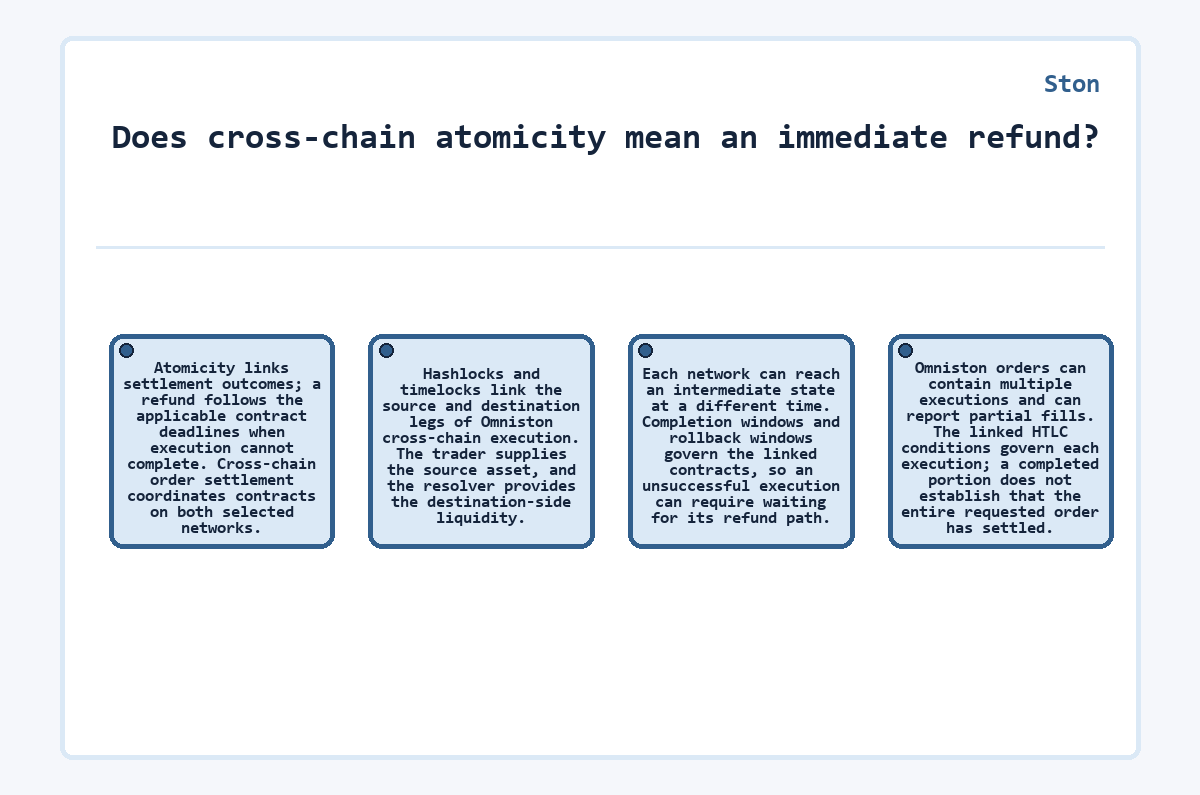
Does cross-chain atomicity mean an immediate refund?
Atomicity links settlement outcomes; a refund follows the applicable contract deadlines when execution cannot complete. Cross-chain order settlement coordinates contracts on both selected networks. Hashlocks and timelocks link the source and destination legs of Omniston cross-chain execution. The trader supplies the source asset, and the resolver provides the destination-side liquidity.
Each network can reach an intermediate state at a different time. Completion windows and rollback windows govern the linked contracts, so an unsuccessful execution can require waiting for its refund path. Omniston orders can contain multiple executions and can report partial fills. The linked HTLC conditions govern each execution; a completed portion does not establish that the entire requested order has settled.
Wallet authorization and receipt mark different stages
Wallet authorization permits execution, while the final settlement status and received balance show the trade’s outcome.
The spending request
The swap transaction or signed order must match the selected asset, amount, and spending operation. A successful source-wallet signature does not establish receipt of the output asset on the destination blockchain. Authorization, submission, and completed settlement remain distinct, including when a gasless flow uses a signed order. Submitting a transaction does not establish that the chain has confirmed it.
The completed balance
For a TON-only trade, the output belongs to the selected receiving address on TON. A cross-chain trade places it on the destination network. The final trade status and corresponding on-chain record establish what settled; the explorer record available after a swap helps distinguish the actual transfer from the earlier estimate.
Compare the received asset and amount with the selected terms, keeping any partial-fill result separate from full completion. A source-side record alone leaves the destination result unresolved. Retaining the transaction identifiers and order details also makes a later support request specific to the trade, without exposing a wallet recovery phrase.
Reviewing a quote without authorizing a swap
Reviewing a quote does not transfer assets. You can stop before signing the swap authorization request. An unexpected receiving network, unacceptable minimum output, or insufficient fee balance gives a concrete reason to stop there. Leaving that request unsigned avoids submitting the proposed swap. A token approval is a separate permission from the exchange itself. Where an EVM flow needs it, granting approval does not establish that the swap completed. A submitted transfer or accepted signed order enters settlement, where any cancellation or return follows the applicable contract rules. Closing the interface does not reverse that submitted action.
New inputs change the next quote
A saved transaction records past execution, while a new swap depends on the terms available at that time. Liquidity, pool fees, and network conditions can change the output and costs. Previous receipt therefore supplies a record of the first trade, without fixing the exchange available for a later amount or destination.
Farming involves liquidity positions, and STON staking has separate participation terms. Continuing with swaps calls for keeping the input asset, destination, and fee requirements aligned with each new request. A different EVM wallet, token, or approval method may also change the authorization needed before the next trade.
Helpful answers
Why can a received TON token be missing from the wallet list?
A TON wallet may need the received jetton added to its displayed token list. Check the completed transfer and receiving address before treating an absent display entry as a failed swap. Adding the correct token to the list changes its visibility; it does not execute another exchange.
Will every cross-chain swap from the same EVM wallet require another token approval?
Another on-chain approval is unnecessary when the existing allowance covers the selected spender and input amount. Reusing a wallet and token does not establish that condition by itself. Permit-based flows may still require a new signed permission, even after an initial approval. The token, wallet, and approval method determine which authorization applies.
How long does a first cross-chain swap usually take?
For the TON/EVM cross-chain flow, swaps often settle in about 15-40 seconds under ordinary network conditions. Other routes and congestion can change the timing. The estimate displayed for the chosen swap concerns settlement speed; the contract has separate deadlines governing rollback or refunds.
Do I need to provide liquidity before making my first swap?
Providing liquidity is a separate operation from exchanging tokens through existing liquidity. A swap uses the liquidity available to its quoted route, without requiring the trader to create a pool position. Depositing assets into a pool creates a different position, with pool exposure and its own withdrawal considerations.
What should I do if my first swap reports a price update?
Review the replacement quote before authorizing the swap. Compare its output, minimum received, and costs with the terms that you intended to accept. Reducing the requested amount can change the available quote. Raising slippage tolerance permits less favorable execution terms, so it changes the outcome that the request allows.
Does connecting the swap screen require my wallet recovery phrase?
Wallet connection does not require entering a recovery phrase into the swap screen. The compatible wallet handles transaction authorization through its own approval process. A request for that phrase on the swap screen is a reason to stop; it is not a prerequisite for obtaining a quote or signing the trade.